

BU33TA2WHFV
1ch 200mA CMOS LDO Regulators
BU33TA2WHFV
1ch 200mA CMOS LDO Regulators
Quick Download
Description
BU**TA2WNVX /HFV系列是一款搭載超小型封裝SSON004X1216 (1.2mm×1.6mm×0.6mm) & HVSOF5(1.6mm×1.6mm×0.6mm)的200mA輸出高性能FULL CMOS穩壓器。電路電流僅需40μA,並具備絕佳的干擾特性及負載反應特性,最適合應用於邏輯IC用電源、RF用電源、相機模組用電源等各種用途。
Product Detail
Specifications
ch
1
Withstand Voltage (Max.)[V]
6.5
Vin(Min.)[V]
2.5
Vin(Max.)[V]
5.5
Iout(Max.)[A]
0.2
Vout Type
Fixed
Vout Accuracy
±1.0% (Ta=25℃)
Circuit Current[mA]
0.04
Dropout Voltage (Typ.)[V]
0.3(Io=0.2A)
Ripple Rejection [dB]
65
Load Regulation[mV]
10(Io=0.01mA to 100mA)
Output Capacitor[µF]
0.5
Shutdown Function
Yes
Thermal Shut-down
Yes
Over Current Protection
Yes
Over Voltage Protection
No
Under Voltage Lock Out
No
Discharge Function
Yes
Soft Start
No
Package
HVSOF5
Reference Code
HVSOF-5
Operating Temperature (Min.)[°C]
-40
Operating Temperature (Max.)[°C]
85
Features
・±1%的高精密度輸出電壓・高漣波抑制
・內建輸出放電電路
Reference Design / Evaluation Tool
-
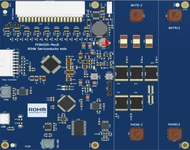
- Reference Design - REF68008
- Industrial 16-Cell BMS Evaluation Platform with ML5238GA AFE and ML63Q8057 MCU
This Battery Management System (BMS) platform provides detailed specifications for an industrial-grade lithium-ion battery monitoring and protection solution. It is designed to support reliable operation in demanding industrial energy storage and power backup applications.
The BMS evaluation platform serves as a reference design for assessing a multi-cell battery monitoring system utilizing ROHM’s ML5238 16-cell Analog Front End (AFE) in combination with the LAPIS ML63Q8057 microcontroller. The system enables accurate cell voltage measurement, current sensing, temperature monitoring, cell balancing, state-of-charge estimation, and fault detection, forming a complete solution for industrial battery packs.
This evaluation kit integrates the core functional blocks required for BMS operation, including the monitoring circuitry, control firmware, sensing interfaces, non-volatile memory, and PC communication interface. The design is optimized for robustness, measurement accuracy, and long-term reliability, making it suitable for industrial energy storage systems, uninterruptible power supplies (UPS), e-mobility auxiliary systems, and stationary battery applications.
The reference design includes comprehensive technical resources such as firmware architecture documentation, communication protocol definitions, memory maps, and configuration guidelines. It features a fully functional BMS firmware implementation optimized for industrial environments, supporting protection mechanisms, data logging, diagnostics, and seamless interfacing with a host PC or supervisory controller.
Users are encouraged to explore the advanced monitoring, protection, and diagnostic capabilities of this BMS evaluation platform and consider its integration or customization for their industrial battery management and energy storage development projects.
